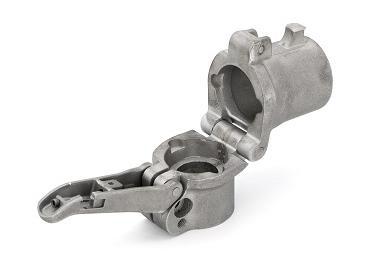
A356.2-T6 folding component
The arms, ribs and pivot openings put the material and machining decisions in the same part. Review the loaded sections, pivot fits and final dimensions after heat treatment together.
Materials / TECHNICAL GUIDE
Our squeeze-casting portfolio includes A356-family enclosures and an A356.2-T6 folding component. Review the alloy, heat treatment and machined features together when developing your own aluminum part.
Discuss your part ↗Drawings, sketches, photographs or an early specification are welcome.
ALLOY SELECTION
A356 with a specified temper is a different engineering choice from simply changing the material name on a conventional die casting drawing.
A356 FAMILY / FACTORY PORTFOLIO
Two examples from the manufacturing team's squeeze-casting portfolio show where the material decision meets the part geometry.
The arms, ribs and pivot openings put the material and machining decisions in the same part. Review the loaded sections, pivot fits and final dimensions after heat treatment together.
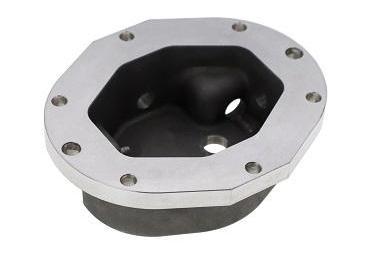
The machined perimeter, fixing holes and enclosed cavity create a different inspection task. Flange geometry and any sealing requirement need their own acceptance checks.
These photographs document portfolio examples. They do not establish mechanical properties or leakage results for a new part. A356 and A356.2 designations should be checked against the specification used for the order.
01 / Materials
Squeeze casting is a core manufacturing route for our aluminum components, including the A356-family examples shown here. Pressure is applied during solidification; tooling, filling and feeding are developed around the part geometry. For a transfer project, review the existing tool and alloy condition rather than assuming a conventional die casting tool can be reused unchanged.
For loaded brackets or similar components, identify the critical sections and the property requirement in the final condition. Compare the complete route, including heat treatment, straightening if required, machining and inspection.
02 / Materials
Where T6 is specified, the process includes solution treatment, quenching and artificial aging. Thermal processing can affect dimensions, so the machining sequence and final dimensional acceptance need to account for it.
Do not infer a guaranteed property from the temper suffix alone. The specification should establish the test method, specimen source and required values. Separately cast coupons, attached specimens and samples removed from a part do not necessarily represent identical material histories.
03 / Materials
Material chemistry, internal soundness and mechanical properties answer different questions. A conforming composition does not demonstrate that a highly loaded section meets its integrity requirement.
Define radiographic or section-evaluation zones where needed, and specify leak testing separately for pressure boundaries. If switching from ADC12 or A380, revisit geometry, tooling, process and finish instead of treating the change as a purchasing substitution.
MATERIALS / PROJECT DETAILS
| Subject | Technical definition | Useful evidence |
|---|---|---|
| Casting route | Squeeze casting or another agreed route | Route-specific sample plan |
| Heat treatment | Required temper and operation sequence | Condition and batch-linked process records |
| Mechanical properties | Specimen source, orientation where relevant and method | Representative test results |
| Final geometry | Post-treatment and post-machining condition | Datum-based dimensional report |
The quotation and agreed inspection plan establish which records and checks apply to the project.
COMMON QUESTIONS
No single ranking covers every condition and property. Compare the specified material condition and representative data for the service requirement.
Yes. Describe the loads, environment and mating requirements. The grade, condition and validation scope can be resolved during the technical discussion.
RELATED GUIDES
Send the part’s purpose, available files and the question you need to resolve. Material, process and inspection details can be developed during the review.